
 PDF Download
 PubReader
 Export Citation
 Email the Author
 Share Facebook
 Share Twitter
 Cited by 0 Article
 Metrics (View:2,616)







INTRODUCTION
Advanced industrialization significantly impacts not only lifestyle diseases but also the health of children, leading to problems such as obesity and depression in anthropometric growth and development, and scoliosis and forward head posture (FHP) in the musculoskeletal system.1–4 School-age children experience rapid changes in musculoskeletal systems, including height, weight, and BMI, as growth plates are open across all joint surfaces.5 Global performance measures for children’s anthropometric growth and development are based on height gain without excessive weight gain.6,7 To this end, analyzing the trajectories of height and BMI changes by age can help determine healthy growth and development.7 While global information on BMI in school-age children and adolescents has been steadily accumulating, there has been little global or comparable domestic research on age-related height changes.8 However, regional anthropometric data for school-age children remain scarce in South Korea, particularly in rural and depopulating areas such as Janghang-eup.
Domestic health policies lack comparative analysis and analysis of regional child and adolescent growth and development. The "Korean Longitudinal Study of Child Growth and Development," a panel survey that tracks children born in 2008 through adulthood in 2027, comprehensively examines various areas, including anthropometric growth (height, weight, BMI, etc.), cognition, emotional development, family, society environment, and health behaviors.9 The Ministry of Health and Welfare's Comprehensive Child Status Survey is a national survey that comprehensively assesses the lives of children and adolescents, including physical, cognitive, and emotional development, family relationships, peer relationships, safety, and the physical environment.9 Conversely, despite research findings demonstrating the direct impact of anthropometric characteristics on life, biological factors such as anthropometric changes and lifestyle habits, such as the risk of musculoskeletal diseases, remain limited.
The need for neck and spinal health management is growing due to prolonged use of smart devices, which leads to inappropriate sitting postures.10,11 Furthermore, the worsening of scoliosis is expected to threaten secondary health problems such as decreased cardiopulmonary function and gastrointestinal complications.12,13 Childhood are periods of active musculoskeletal development and body structure formation. Appropriate anthropometric activity is a key factor in promoting healthy growth and development. Janghang-eup is recognized as a depopulating rural area with a steadily decreasing school-age population. Monitoring the growth and musculoskeletal status of children in such regions is important for identifying potential disparities caused by limited community resources and reduced opportunities for physical activity. The purpose of this study was to analyze anthropometric and musculoskeletal indicators among school-aged children in Janghang-eup using a cross-sectional design.
METHODS
This study was a cross-sectional study design. After the study was designed and approved by the Baekseok University Institutional Review Board (IRB No. BUIRB-202508-HR-066), recruitment materials were distributed to elementary schools in Janghang-eup through the Chungnam Office of Education. Students who expressed interest in participation through these materials were subsequently provided with detailed explanations regarding the study’s objectives and the intended use of collected data, after which informed consent for participation was obtained from both the students and their parents.
This study was participated by elementary students located on Janghang-eup, Seocheon-gun, Chungnam. The inclusion criteria were as followings: (1) Students aged 10-12 years attending elementary schools; (2) Students who can fully understand the research process and follow the instructions of the researcher; (3) Students with no neurological disorders that could affect the study results; (4) Students who have not participated in similar studies that could influence the results within the past year; (5) Students who voluntarily wish to participate in the study after receiving an explanation about it; and (6) Students whose legal guardian has understood the explanation of the study and has given voluntary permission for participation. The students included excluded the students who express withdrawal from participation during the study, students who collected data show missing values that could significantly affect the study results, and students who an able to communicate in Korean. The final number of participants selected, after applying the inclusion and exclusion criteria, was 167 students.
The study focused on the anthropometric measurements of children and the data collected included: general characteristics of participants and anthropometric measurements. General characteristics of children encompassed information on age, sex, and grade level. Anthropometric measurements included height, weight, BMI, waist circumference, maximal grip strength (an index of upper limb and whole-body muscle strength) and, craniovertebral angle, and scoliosis angle.
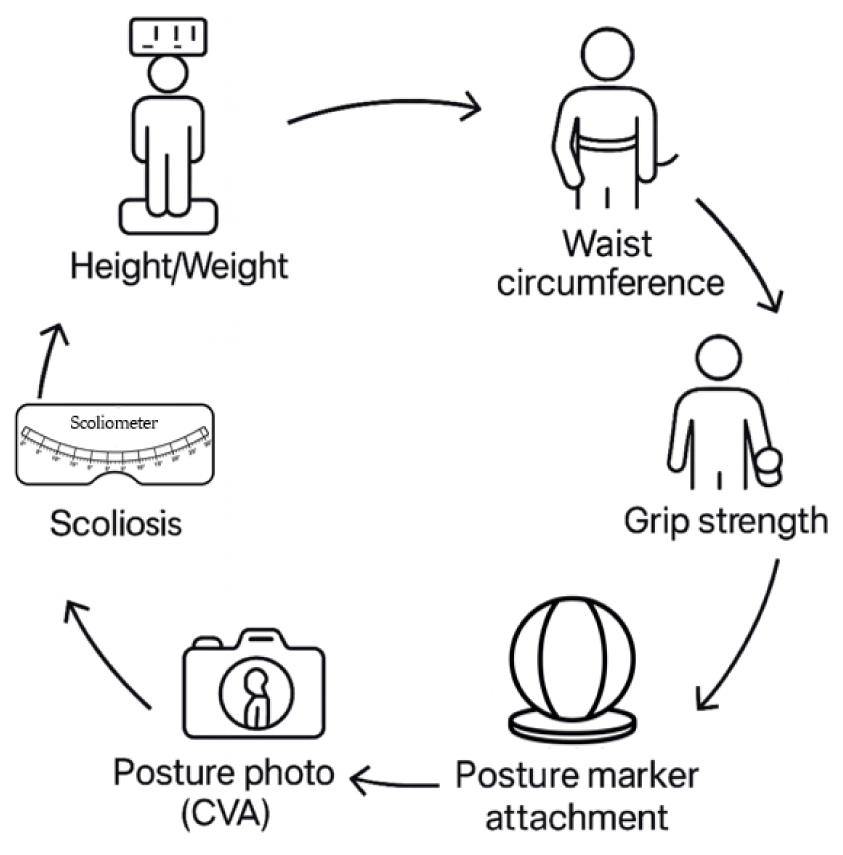
All anthropometric measurements were conducted in a quiet and organized school health room following a standardized measurement sequence. Upon entering the room, each participant first completed basic identification information, after which measurements were performed in the following order: (1) height and weight, (2) waist circumference, (3) maximal grip strength, (4) craniovertebral angle, and (5) thoracic and lumbar scoliosis angles. Height and weight were measured twice, and the mean values were used for analysis. Maximal grip strength, craniovertebral angle, and spinal angle were each measured three times, with mean values included in the analysis. The number of repetitions was determined based on measurement reliability considerations. Height and weight were measured twice as they are known to show minimal intra-individual variability, whereas other measurements, which may fluctuate depending on posture or effort, were repeated three times to improve reliability. Craniovertebral angle and maximal grip strength were assessed on the dominant side.
Anthropometric variables were assessed using five standardized instruments: an InBody device (InBody Co., Ltd., Seoul, South Korea) for measuring height and weight; a hydraulic grip dynamometer (Jamar, SME, Inc., Wilmington, USA) for grip strength; a smartphone (Galaxy S23, Samsung Electronics, Suwon, South Korea) with ImageJ software (National Institutes of Health, Bethesda, MD, USA) for craniovertebral angle assessment; a tape measure (seca 200, Seca, Germany) for waist circumference; and a scoliometer (Baseline®, Fabrication Enterprises Inc., White Plains, NY, USA) for thoracic and lumbar scoliosis angles. All assessments were conducted by trained examiners following a consistent measurement protocol. The overall measurement sequence is illustrated in Figure 1. Further details of measurement procedures including anatomical landmarks, device positioning, participant posture, and imaging methodology are provided in Table 1.
| Measurements | Detailed measurement procedures |
|---|---|
| Height and weight | The researcher instructed the participant to stand barefoot on the InBody device and assume a standard anatomical posture.14 Participants stood barefoot on the device in a standard anatomical posture. Measurements were initiated after maintaining the static posture for approximately 10 seconds. |
| Waist circumference | Waist circumference was measured by standing at the participant’s side, with the measurer identifying the lower edge of the last rib and the upper edge of the iliac crest. A tape measure was placed midway between these two points, ensuring that the tape measure was parallel to the floor. After exhaling, the tape measure was pulled back enough to avoid pressing on the skin, and measurements were taken to the nearest 0.1 cm.15 |
| Maximal grip strength | Maximal grip strength was measured with the participant seated upright on a chair. The participant grasped the hand dynamometer with the shoulder adducted and in a neutral position, the elbow flexed at 90°, the forearm in a neutral position, and the wrist positioned in 0°–15° extension and 0°–15° radial deviation. The dynamometer was aligned directly with the participant’s hand and forearm. Prior to testing, the hand and arm were inspected for pain or previous surgical history. Participants were instructed to exert maximal voluntary force during each trial. All measurements were performed on the dominant hand only, and three repeated trials were conducted. To minimize muscular fatigue, a 5-minute rest interval was provided between each trial.16 |
| Craniovertebral angle | The craniovertebral angle was used to assess forward head posture. The measurement was performed with the participant seated upright on a chair, while a camera was positioned 80 cm away at shoulder height. Circular markers were placed on the participant’s C7 spinous process and tragus, and the participant was instructed to sit comfortably and look straight ahead. While maintaining a forward gaze and relaxed breathing, a lateral photograph was taken from the dominant side. The captured images were analyzed using ImageJ software to quantify the angle of head posture, defined as the angle formed between the line connecting the midpoint of the tragus and the C7 spinous process and a horizontal line passing through the C7 spinous process.17 A CVA of less than 48° is considered indicative of forward head posture in children, and a smaller CVA value reflects a greater severity of forward head posture.18 |
| Scoliosis angles | Thoracic scoliosis angle and lumbar scoliosis angle were measured using a scoliometer. Scoliosis was assessed using a scoliometer. The participant stood upright and barefoot, with both arms parallel and flexed at the shoulder joints to 90°, palms together. The participants then slowly flexed forward at the waist, lowering the shoulders to hip level. The examiner positioned the scoliometer along the midline at the level of the most prominent vertebrae and recorded the maximum angle.12 Measurements were obtained for both the thoracic and lumbar regions of the spine. A scoliometer reading is widely adopted as the primary screening measure for scoliosis, and a value of ≥5° is typically applied as the diagnostic cutoff.19 |
This study analyzed the general characteristics (dominant side, school grade) and anthropometric measurements (height, weight, BMI, thoracic scoliosis angle, lumbar scoliosis angle, and CVA) of the participating students using descriptive statistics (frequency, percentage, minimum, maximum, mean, and standard deviation). To compare the children's anthropometric measurements across age groups, the values representing height-for-age, weight-for-age, and BMI-for-age were utilized. According to the national growth chart, children whose measurements were below the minimum for their age were classified as having low height, low weight, or low BMI, while those whose measurements were above the maximum for their age were classified as having high height, high weight, or high BMI. Height, weight, and BMI categories based on the values are presented as frequencies and percentages. Two-way ANOVA was conducted to examine the effects of age and gender on the anthropometric and musculoskeletal indicators. When the interaction effect was not statistically significant, the main effects of age and gender were interpreted independently. When a significant main effect of age was identified, post-hoc comparisons were performed using the Bonferroni test. However, when a significant interaction effect was detected, pairwise comparisons were conducted to examine simple effects within each age–gender subgroup.
Pearson correlation analysis was used to determine the relationships among anthropometric and musculoskeletal indicators. The strength of the correlation coefficients was interpreted as follows: values of 0.00–0.10 were considered negligible, 0.10–0.39 weak, 0.40–0.69 moderate, 0.70–0.89 strong, and 0.90–1.00 very strong.20
All statistical analyses were performed using the Windows statistical package SPSS version 29 (IBM, Chicago, USA) and the alpha level for statistical significance was set at 0.05.
RESULTS
This study included 167 elementary school students (72 boys and 95 girls). Of these, 61 were 10 years old (29 boys, 32 girls), 59 were 11 years old (26 boys, 33 girls), and 47 were 12 years old (17 boys, 30 girls). In the 10-year-old group, 54 students (26 boys, 28 girls) were right-handed, and 7 students (3 boys, 4 girls) were left-handed. Fifty-three students (28 boys, 25 girls) were in the fourth grade, and eight (1 boy, 7 girls) were in the fifth grade. Three students (2 boys, 1 girl) had a thoracic scoliosis angle of 5°or more, and one girl had a lumbar scoliosis angle of 5°or more. A CVA of less than 48° was observed in 48 students (23 boys, 25 girls), accounting for 78.7% of this age group. When comparing the participants' height, weight, and BMI to the standard growth values for their age and sex, 7 boys and 11 girls were shorter than the standards, while 12 boys and 8 girls were taller. In terms of weight, 10 boys and 12 girls were below the standard, whereas 18 boys and 16 girls exceeded it. For BMI, 9 boys and 10 girls had values lower than the standard, while 18 boys and 19 girls had higher values (Table 2, 3).
In the 11-year-old group, 52 students (23 boys, 29 girls) were right-handed and 7 (3 boys, 4 girls) were left-handed. Forty-seven students (22 boys, 25 girls) were in the fifth grade and twelve (4 boys, 8 girls) were in the sixth grade. Three students (1 boy, 2 girls) had a thoracic scoliosis angle of 5° or more, and two students (1 boy, 1 girl) had a lumbar scoliosis angle of 5°or more. A CVA of less than 48° was noted in 41 students (19 boys, 22 girls), representing 69.5% of this group. When comparing the participants' height, weight, and BMI to the standard growth values for their age and sex, 5 boys and 5 girls were shorter than the standards, while 13 boys and 20 girls were taller. In terms of weight, 6 boys and 5 girls were below the standard, whereas 11 boys and 20 girls exceeded it. For BMI, 6 boys and 9 girls had values lower than the standard, while 16 boys and 18 girls had higher values (Table 2, 3).
In the 12-year-old group, 41 students (14 boys, 27 girls) were right-handed and 6 (3 boys, 3 girls) were left-handed. All 47 students (17 boys, 30 girls) were in the sixth grade. Two students (1 boy, 1 girl) had a thoracic scoliosis angle of 5°or more, and four students (1 boy, 3 girls) had a lumbar scoliosis angle of 5° or more. Twenty-eight students (10 boys, 18 girls) had a CVA of less than 48°, accounting for 59.6% of this age group. When comparing the participants' height, weight, and BMI to the standard growth values for their age and sex, 4 boys and 7 girls were shorter than the standards, while 5 boys and 13 girls were taller. In terms of weight, 2 boys and 9 girls were below the standard, whereas 12 boys and 15 girls exceeded it. For BMI, 3 boys and 13 girls had values lower than the standard, while 13 boys and 17 girls had higher values (Table 2, 3).
No significant interaction effect between age and gender was found across all anthropometric and musculoskeletal indicators (p>.05, Table 4). The main effects analysis demonstrated significant age-related differences in height, weight, waist circumstance, maximal grip strength, and CVA. Height increased progressively and significantly with age, and weight, waist circumstance and maximal grip strength were significantly higher in participants aged 11 and 12 compared with those aged 10, although no significant difference was found between ages 11 and 12. Similarly, maximal grip strength was greater at ages 11 and 12 than at age 10, but no significant difference was observed between ages 11 and 12. CVA was significantly smaller at age 10 compared with age 12, indicating a more pronounced FHP in younger participants; however, no significant differences were observed between ages 10 and 11 or between ages 11 and 12. In contrast, BMI, TSA, and LSA did not show significant age-related differences (Table 5). Additionally, BMI and waist circumference were significantly higher in boys than in girls, whereas no significant sex-related differences were observed in the remaining variables (Table 6).
Correlation analysis was conducted to examine the relationships among height, weight, BMI, waist circumference, maximal grip strength, CVA, TSA, and LSA. The results showed that height demonstrated moderate positive correlations with weight (.695***) and maximal handgrip strength (.614***). Weight also showed a moderate positive correlation with maximal handgrip strength (.529**), a very strong correlation with BMI (.906***), and a strong positive correlation with waist circumference (.887***). BMI exhibited a very strong positive correlation with waist circumference (.908***), and weak correlations with height (.341***), maximal handgrip strength (.345***), and CVA (–.360***). Waist circumference showed a strong positive correlation with weight (.887***) and a very strong positive correlation with BMI (.908***). Maximal handgrip strength demonstrated moderate positive correlations with height (.614***) and weight (.529***). CVA showed weak negative correlations with weight (–.209**) and BMI (–.360***). Finally, TSA showed a moderate positive correlation with LSA (.570***). These findings are summarized in Table 7.
DISCUSSION
A child's physical growth directly influences their intellectual, emotional, and psychological development, making it a crucial health indicator that also affects academic achievement. The results of this study reveal that children in Janghang-eup have a high obesity rate relative to their height. While many students were taller than the national standards for their age and gender, more were overweight, and many were obese with a high BMI. Furthermore, boys showed higher mean BMI values than girls, with approximately a 10% difference, reflecting a global trend.8 However, Table 5 showed that this pattern slightly reversed at age 12, with girls exhibiting higher BMI than boys, which may be related to the earlier onset of puberty typically observed in females. Shah et al. investigated the gender-related impact of childhood obesity in 188 countries and reported that boys were more obese than girls in 65% of 5- to 9-year-olds and 60% of 10- to 19-year-olds. This pattern persisted except in low-income countries, with boys having higher obesity rates than girls in higher-income countries.2 Conversely, a domestic study examining the body composition of 15 boys and 15 girls in elementary school reported that although more boys were overweight than girls, there was no difference in BMI between the sexes.21 The study did not report regional characteristics of the participants, and the small sample size limits generalizability. However, another previous study showed that the BMI of boys was higher than that of girls, consistent with the findings of the present study.22 These findings may also be influenced by the characteristics of Janghang-eup, a depopulating rural area. Reduced peer groups and limited access to community health resources may restrict children’s opportunities for regular physical activity, potentially contributing to the higher BMI observed in this population.
In addition to measuring children's body measurements, this study measured scoliosis and FHP to screen for musculoskeletal problems and provided basic data for physical activity education for children. The results showed that less than 5% of students had scoliosis angles greater than 5°, a criterion for suspected scoliosis, for both thoracic and lumbar scoliosis.19 One of the largest domestic studies on childhood scoliosis examined scoliosis in one million children from 2000 to 2008. This study reported that the prevalence of idiopathic scoliosis in boys and girls aged 10 to 12 years was 2.37% and 5.57%, respectively. This represents the percentage of students who screened positive for scoliosis using a goniometer and then underwent a Cobb angle from X-ray diagnosis. This percentage corresponded to approximately 50% of the cases diagnosed with the goniometer screening test.12 Therefore, this study can be lower than the incidence rate of idiopathic scoliosis and were not particularly exposed to scoliosis. These comparisons are limited because our measurements were based on a scoliometer screening test, whereas the national study used Cobb angle measurements, the diagnostic gold standard.
The CVA, which is the criterion for diagnosing FHP, was less than 48 degrees in more than 70% of all students. When broken down by gender, the proportion of male and female students with a CVA less than 48 degrees was about 4% lower in female students, but this difference was not significant. On the other hand, when examining the CVA less than 48 degrees by age, the proportion of students with a CVA less than 48 degrees significantly decreased with increasing age. Notably, BMI showed a significant negative correlation with CVA, suggesting that children with higher BMI demonstrated poorer postural alignment. The absence of a correlation between maximal grip strength and CVA may reflect that maximal grip strength represents short-duration phasic strength, whereas FHP is more closely influenced by tonic postural endurance. In boys, the risk of FHP was approximately 20% higher at age 10 than at age 12, and in girls, the risk was approximately 18% higher at age 10 than at age 12. According to previous research, this can be interpreted in two ways.5,17 A study that investigated CVA and back muscle endurance in 288 children aged 7 to 10 reported that children with lower trunk extension endurance had a lower CVA and thus showed FHP.5 In our study, the rate of positive responses to FHP was higher in younger children. Because the growth ages of the participants in this study differed from those in previous studies, and because the human spine generally has the same curvature as an adult starting at age 10, it is difficult to generalize based on previous studies.23,24 Therefore, although back muscle endurance was not assessed in this study, it is thought that tracking children’s back muscle endurance may be necessary to understand why the positive response to FHP in 10-year-old children was higher than that in 12-year-olds. Furthermore, more than 70% of the participants in this study showed a positive response to FHP. If this result is due to children's low endurance to maintain an upright sitting posture, it is thought that education on proper posture, such as sitting properly, standing properly, and walking properly, is necessary for growing children. In line with the BMI-related findings noted earlier, similar environmental constraints in this depopulating rural area may also contribute to the high prevalence of FHP.
These findings suggest the need to increase physical activity and to implement strategies for correcting FHP in children. However, because the study was limited to a rural area in South Chungcheong Province, its findings cannot be generalized to the nationwide child population. In addition, physical characteristics that typically serve as indicators of obesity, such as body fat percentage and muscle mass, were not measured. Future studies should include both urban and rural populations and incorporate more comprehensive anthropometric variables to provide a stronger evidence base for promoting physical activity in educational settings. Another limitation of this study is that a portion of the waist circumference data was initially entered in inches rather than centimeters. Although these values were later corrected using the standard conversion factor (1 inch = 2.54 cm) and no additional errors were identified, this issue should be acknowledged. In addition, interventional studies using structured exercise programs are needed to determine whether musculoskeletal indicators such as posture, muscle balance, and body composition can be improved through targeted physical activity.
CONCLUSIONS
This study aimed to provide a practical foundation for developing physical education programs for children by conducting physical measurements of students in grades 4 to 6 at three elementary schools located in Janghang-eup, a fishing village in Seocheon-gun, Chungcheongnam-do. The results showed that more than 50% of the participants had a body mass index (BMI) higher than the national growth reference, and over 70% exhibited FHP. Children’s height, weight, maximal grip strength, and CVA increased with age. In contrast, BMI, waist circumference, thoracic scoliosis angle, and lumbar scoliosis angle were not affected by age. Furthermore, no interaction between age and gender was found for children’s anthropometric measurements.


