
 PDF Download
 PubReader
 Export Citation
 Email the Author
 Share Facebook
 Share Twitter
 Cited by 0 Article
 Metrics (View:2,087)







INTRODUCTION
Neck and shoulder pain is a common musculoskeletal problem in a clinical setting.1 The neck and shoulder muscles, including the upper trapezius, play a role in maintaining posture and performing repeated activities of the upper extremities against gravity.2,3 Therefore, neck and shoulder pain could be caused by stiffness, a hyperirritable spot or decreased elongation of the upper trapezius.4-6 A previous study found that 58-73% of individuals with neck and shoulder pain had an upper trapezius problem.7
Many clinicians and researchers have attempted to alleviate the stiffness and pain of the upper trapezius using non-pharmacological techniques, such as instrument-assisted soft tissue mobilization, massage, muscle energy techniques, and stretching.8-10 Among these maneuvers, stretching is one of the easiest and most commonly used maneuver for addressing problems with the upper trapezius.11-12 Previous studies have shown that stretching exercises for the neck and shoulder muscles, including the upper trapezius, can reduce pain, increase muscle elongation, and improve cervical range of motion (ROM).8,11,12
In general, stretching exercises are performed in the direction of muscle elongation.13-15 Based on this mechanism, upper trapezius stretching exercises are often performed alongside cervical flexion, ipsilateral cervical rotation and contralateral lateral flexion movements.11,16 However, this stretching maneuver overlooked clavicular movement. As the upper trapezius is attached to the lateral portion of the clavicle,17 clavicular protraction could, in theory, elongate the upper trapezius. Similar to this hypothesis, a previous study has reported that stretching maneuver that lengthens the anatomical length of the levator scapulae muscle is effective in increasing its length.18 However, no studies that have verified the effectiveness of combining upper trapezius stretching with clavicular protraction using effect size (ES) and confidence intervals. Thus, the aim of the present study was to identify the effects of upper trapezius stretching with clavicular protraction on pressure pain threshold (PPT) of the upper trapezius and cervical ROM.
METHOD
This study included 15 adults (8 males and 7 females; mean age: 20.40±1.45 years; mean height: 171.53±9.88 cm; mean weight: 71.33±17.90 kg) who had tender points in their upper trapezius muscle and PPT of less than 2.9 kg/cm2 in the same area.19 This study excluded individuals who had been diagnosed with musculoskeletal disorders affecting the neck and shoulders.19 If the inclusion criteria for both upper trapezius muscles were met, the intervention was performed on the side with the lower PPT.
A power analysis was used to determine the sample size for this study. The analysis used a statistical power of 80%, an α-value of 0.05 and an effect size of 0.8. Power analysis showed that at least 12 participants were needed. However, considering dropouts, the sample size for this study was determined to be 15 participants. The Catholic University of Pusan Institutional Review Board approved the study protocol (IRB No. CUPIRB-2024-023), and all participants signed the written informed consent form.
The PPT of the upper trapezius was measured using a Force Dial FDK 20 algometer (Wagner Instruments, Greenwich, USA), both to determine whether the inclusion criteria were met and to obtain the necessary data. To take the measurements, the examiner pressed the algometer tip perpendicular to the tender point of the participant’s upper trapezius muscle while the participant sat down.19,20 To ensure that the PPT measurement area was the same before and after the intervention, the tender point was marked with tape, and the same examiner performed the measurements. Participants were asked to say ‘stop’ when they experienced pain or an uncomfortable sensation.19,20 Measurements of PPT of the upper trapezius were taken three times, with a 30-second rest period before and after exercise.
The cervical ROM for contralateral lateral flexion and ipsilateral rotation were measured using a cervical ROM device (CROM; Performance Attainment Associates, St. Paul, USA). The participant placed the CROM device on their head and sat up straight.8 The examiner asked the participant to perform a maximal active cervical contralateral lateral flexion or an ipsilateral rotation.8 During cervical movements, the examiner monitored compensatory movements, such as lateral flexion of the trunk, elevation of the shoulders or rotation of the trunk. The examiner measured the maximum cervical ROM three times in each direction, both before and after the exercises.
The participant adopted an upright sitting position, placing both hands on their thighs. The examiner placed one hand on the participant’s temporal bone region and the other on their acromion, over the tender point of the upper trapezius muscle, with both hands crossed. The examiner performed the following maneuvers on the participant: passive cervical flexion, ipsilateral rotation and contralateral lateral flexion. The examiner stopped the movements when they felt firm end-feel and maintained the end range of cervical flexion, contralateral lateral flexion and ipsilateral rotation for 30 seconds. If the participant complained of pain caused by stretching, the intensity was reduced to an acceptable level. To induce clavicular protraction during passive upper trapezius stretching, the participant moved their hands towards the patella as much as possible and held the position (Figure 1). All stretching exercises were performed by a primary examiner. Another examiner monitored participant’s upright sitting position during stretching exercise. A total of three sets of stretching exercises were performed, with a 10-second rest period between each set.
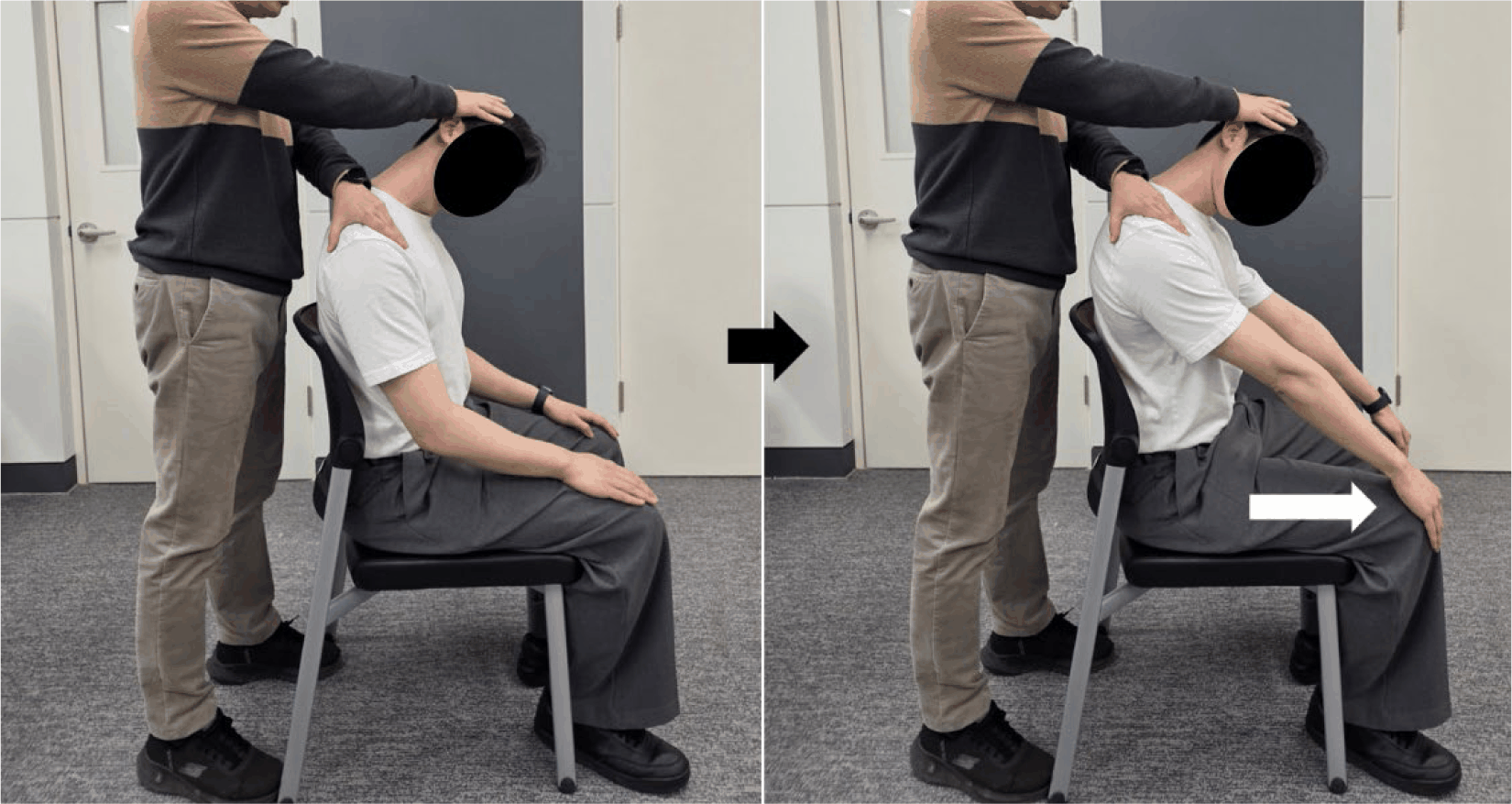
Examiners measured PPT and cervical ROM for contralateral lateral flexion and ipsilateral rotation in a randomized order. After taking the measurements, an examiner performed 90 seconds of upper trapezius stretching with clavicular protraction on the participants. Immediately after stretching, the same measurements were repeated in a randomized order.
The intra-rater reliability of all the repeated-measure variables was identified using the intraclass correlation coefficient (ICC3,3). For data analysis, the mean values of three measurements for each dependent variable were calculated, both before and after exercise. In the Shapiro-Wilk test, only cervical contralateral lateral flexion ROM in the pre-exercise condition did not satisfy a normal distribution (p=0.023). Therefore, significant changes were confirmed using a Wilcoxon signed-rank test for cervical contralateral lateral flexion ROM and paired t-tests for the remaining dependent variables in the IBM Statistical Package for the Social Sciences (version 29.0; IBM Corp., Armonk, USA). The statistical significance level (α-level) was set to 0.05.
RESULTS
Table 1 shows the descriptive data and ICC values. The PPT of the upper trapezius and ROM of cervical contralateral lateral flexion and ipsilateral rotation increased significantly after exercise. (p<0.001; Table 1).
DISCUSSION
This present study shows that upper trapezius stretching with clavicular protraction increases PPT and cervical ROM.
This study found that PPT increased significantly following upper trapezius stretching with clavicular protraction (p<0.001). It is believed that stretching exercises are effective in changing mechanical sensitivity.8,21-23 Previous studies have found that interventions incorporating stretching are more effective at increasing PPT.21,23 Hanten et al.21 found that combining ischemic pressure and stretching increased PPT more effectively than active cervical motion exercises. Similarly, Wilke et al.23 found that combining acupuncture with stretching increased PPT more than acupuncture alone. In addition, a previous study suggested that the minimum detectable change (MDC) value for upper trapezius PPT was 0.45–1.13 kg/cm2,24 and our study result (0.49 kg/cm2) was also within this range. Thus, as the change in the PPT of the upper trapezius after stretching in the present study was within the range of the minimum detectable change, it can be concluded that upper trapezius stretching with clavicular protraction is effective in changing the PPT. Also, the results of this study support the results of previous research22 that upper trapezius stretching alone increases the PPT of the upper trapezius.
This study found that cervical ROM increased significantly after exercise (p<0.001). This finding is consistent with previous studies that have reported an increase in cervical ROM following upper trapezius stretching.22,25 Anatomically, the upper trapezius has moment arms for cervical extension, ipsilateral lateral flexion and contralateral rotation movements,26 which are in the opposite directions to the stretching movements performed in this study. It is therefore believed that cervical flexion, contralateral lateral flexion and ipsilateral rotation movements selectively elongate the upper trapezius muscle, thereby increasing cervical ROM. A previous study using ultrasound shear wave elastography showed that cervical flexion and contralateral lateral flexion increase muscle tension in the upper trapezius, which supports our hypothesis.11 Additionally, changes in pain tolerance and muscle-tendon viscoelastic properties may have influenced the increase in cervical ROM observed in this study.27,28
Given that the arrangement of muscle fibers can affect muscle elongation,¹¹ clavicular protraction may also have influenced the results of this study. A previous study that performed a combined shoulder and cervical movements for levator scapulae stretching demonstrated that a stretching maneuver that lengthens the muscle at both its origin and insertion is effective in increasing muscle length and joint ROM.18 As the upper trapezius is attached to the lateral portion of the clavicle, contracting the upper trapezius pulls the clavicle backwards.29 Thus, the clavicular protraction performed in this study may have contributed to the elongation of the upper trapezius. This may have influenced an increase in cervical contralateral flexion by 6.65° and ipsilateral rotation by 9.9°. Additionally, given that the results of our study exceeded the MDC values for cervical lateral flexion (3.6-6.2°) and rotation (4.9-6.1°),30 it is believed that this upper trapezius stretching with clavicular protraction was an effective intervention for increasing cervical ROM. However, previous studies examining the effectiveness of conventional upper trapezius stretching have shown that the range of change in cervical ROM is highly variable.22,25 A previous study by Buranruk24 found that, after 10 minutes of exercise, the ROM for cervical contralateral flexion and ipsilateral rotation increased by 3.32–4.42° and 0.7–3.69°, respectively. Another study by Oliveira-Campelo et al.21 found that, after 30 seconds of passive upper trapezius stretching, the ROM for cervical contralateral flexion and cervical ipsilateral rotation increased by 9.2° and 4.4°, respectively. These diverse findings are thought to be the result of differences in subject characteristics, the total time of the intervention or interaction with other exercises, and the design of the studies. Thus, it is difficult to determine the effectiveness of adding clavicular protraction based on the findings of previous studies21,24 and the present study. Although the present study demonstrated that upper trapezius stretching with clavicular protraction increases PPT and cervical ROM, future studies comparing the effects of conventional upper trapezius stretching and upper trapezius stretching with clavicular protraction are needed to clarify the effectiveness of clavicular protraction.
Some issues with this study need to be addressed. Firstly, due to the absence of a control group and measurements of clavicular protraction during stretching, the effectiveness of additional clavicular protraction must be objectively demonstrated in future studies. Secondly, as this study only examined the short-term effects of stretching, future study is required to conduct follow-up measurements and determine the long-term effects of stretching the upper trapezius with clavicular protraction. Thirdly, because this study only included 15 adults who had not been diagnosed with musculoskeletal disorders, it is difficult to generalize the results of this study. Thus, future studies need to include patients with neck or shoulder disorders. Finally, although some studies have suggested that the PPT criteria for the upper trapezius should differ between males and females,31,32 this study applied the same PPT criteria to both sexes. Also, because the same examiner measured the dependent variables before and after the intervention, it is difficult to eliminate examiner bias completely.
CONCLUSIONS
Upper trapezius stretching with clavicular protraction increased the PPT of the upper trapezius and ROM of cervical spine. These results imply that this stretching technique could be used to address upper trapezius pain and limited cervical ROM. However, future studies, including a control group, are needed to clearly confirm the effects of additional clavicular protraction.


